
Places > Florence
Tribuna di Galileo
Florence, via Romana 17
Built
at the initiative of Grand Duke Leopold II of Lorraine and situated in Palazzo
Torrigiani, the Tribuna di Galileo was inaugurated in 1841 on the occasion of
the third Congress of Italian Scientists. The building, designed by the
Florentine architect Giuseppe Martelli, was erected in honor of Galileo Galilei
and was conceived as an iconographic synthesis of experimental science. It was
a monument unique of its kind, a "Scientific sanctuary", as it was called by
Vincenzo Antinori, then director of the Museum of Physics and Natural History.
The building abounds in iconographic decoration, with frescoes and bas-reliefs
depicting instruments, famous scientific discoveries and the scientists who
made them.
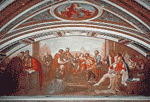
In
particular, the seven lunettes illustrate, with the rhetorical celebration
typical of the 19th century, the development of experimental science according
to a precise, linear chronological sequence. Galileo, of course, is at the
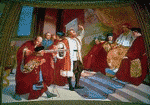
center of the iconographic sequence. The scene opens with Leonardo da Vinci in
the presence of Ludovico Sforza, Duke of Milan; it continues, in the second
lunette, with Galileo shown demonstrated the law of falling bodies, while in
the third we see the Pisan scientist intent on observing the lamp in the Duomo
of Pisa; in the fourth, as he presents his telescope to the Venetian Senate; in
the fifth Galileo, now old and blind, conversing with his disciples; in the
sixth, an experimental session of the Galilean Accademia del Cimento; and
lastly, in the seventh, the logical conclusion of the series: Alessandro Volta,
who is demonstrating to Napoleon the experiment of Volta's battery.
At
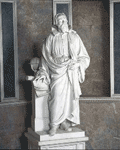
the center of the Tribuna hemicycle stands the statue of the great Pisan
scientist sculpted by Aristodemo Costoli. At the sides were displayed some of
scientific instruments that belonged to Galileo and to the Accademia del
Cimento, now found in the Florence Institute and Museum of the History of
Science.
The
vestibule of the Tribuna was covered by a glass and cast-iron lantern (the
glass has now been replaced by plexiglas) which constitutes one of the first
Florentine models of architecture with a metal structure and is a fine example
of the synthesis of science, technology and the artistic iron-working industry.